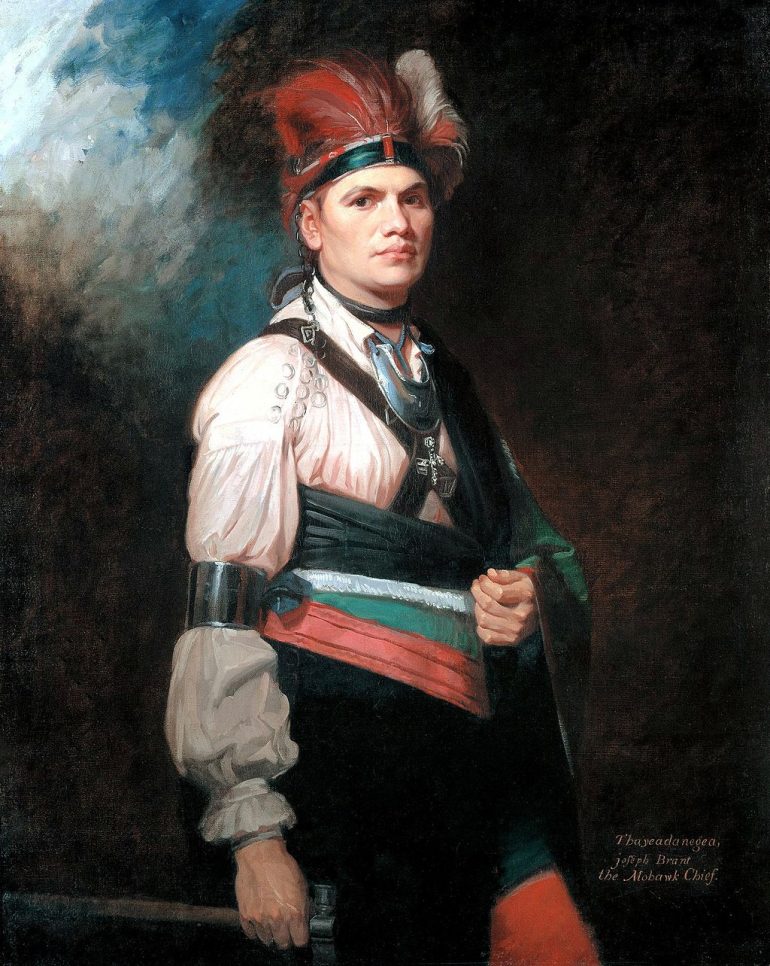
Imagine being a young Mohawk boy in the 1700s, rooted in your own traditions yet surrounded by unfamiliar new worlds. You are raised in the Mohawk way of life, but you also learn from German and English settlers nearby. Unlike most Indigenous children, you’re sent to school, where you become fluent in English and are introduced to Christianity and Western ideas.
You will spend your life moving between two very different worlds.
As a respected war chief, you will carry a ceremonial tomahawk but fight with pistols. You will meet powerful figures, travel across the ocean, and sit down to dine with the King of England himself — who will call you one of his most valued subjects. You will fight bravely in battle, yet later wonder whether you chose the right side.
Meet Thayendanegea
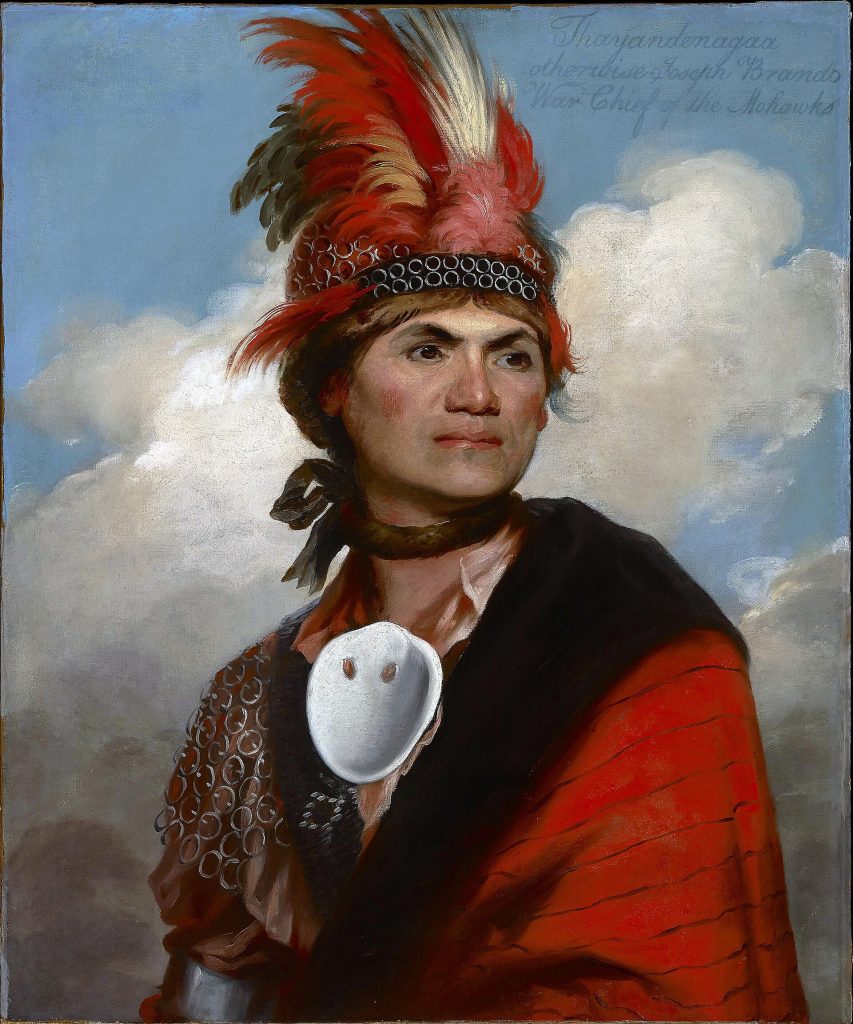
Better known as Joseph Brant, he was born around 1742 in the Ohio Country and raised in the Mohawk Valley of present-day New York. After his father’s early death, his mother returned with her children to the Mohawk village of Canajoharie. There, Brant grew up in a multilingual, multicultural world that would shape the rest of his life.
Brant moved comfortably between cultures. His older sister, Molly Brant, became the partner of Sir William Johnson, the British Superintendent of Indian Affairs, placing the family in close contact with colonial leadership. Brant’s education further set him apart. At a charity school, he studied English, religion, and Western subjects, eventually becoming a skilled interpreter in negotiations between the British and the Haudenosaunee (Six Nations Confederacy).
When war came, Brant sided with the British. He fought in both the Seven Years’ War and the American Revolution, believing the Crown would protect Indigenous lands from American expansion. To strengthen that alliance, he travelled to England, where he met influential leaders and received promises of support.
Back in North America, Brant led a group known as the “Volunteers” — a mix of Indigenous warriors and Loyalists — in raids across New York and Pennsylvania. To his enemies, he became “Monster Brant,” a feared figure on the frontier. Yet some accounts describe him stepping in to prevent unnecessary violence, adding to his complex reputation.
The war, however, divided the Haudenosaunee. After generations of unity under the Great Peace, different nations chose different sides, creating lasting fractures within the Confederacy.
Disillusioned warrior
When the war ended in 1783, the outcome was devastating. In the Treaty of Paris, Britain handed over vast Indigenous territories to the United States — without consulting its allies. Brant, like many others, felt deeply betrayed.
He turned his focus north. In 1784, he successfully secured a land grant along the Grand River in what is now Ontario. About 2,000 Haudenosaunee people resettled there, hoping to rebuild a stable and self-sufficient community.
Brant continued to bridge cultures. He encouraged farming alongside traditional practices and promoted Christianity, while also criticizing aspects of British society, particularly its class divisions and treatment of the vulnerable.
Not all of his decisions were popular. Brant leased and sold portions of the Grand River lands to settlers, hoping to generate income for tools, infrastructure, and long-term stability. Much of that revenue, however, never made its way back to the community. To this day, Brant’s choices remain controversial.
Indigenous diplomat
In his later years, Brant lived near Burlington Bay (now Hamilton Harbour), on land he had acquired from the Mississaugas. He entertained guests in a refined, English style while maintaining strong ties to his Mohawk identity. He continued to travel and negotiate, seeking solutions for his people.
When Joseph Brant died in 1807, much of the original Grand River land had already passed out of Six Nations control. His reported final words — “Have pity on the poor Indians” — offer a glimpse into the weight he carried to the very end.
By Michelle Morra