It’s beginning to look a lot like Christmas. Well, not just yet – but soon, Christmas cheer will be sparkling all over Oakville. This December, explore beautifully decorated and architecturally unique homes in celebration of the holiday season. Through the St. Andrew’s Christmas House Tour, Oakville residents open their homes to the public and welcome visitors to enjoy the wonders of holiday design and seasonal spirit. Each is home decorated by talented local designers.
This time-honoured tradition has spanned decades, now entering it’s 20th year and engaging the third generation of organizers. In the mid-nineties, the founder’s daughter, Stephanie Pierce, took over the planning of the tour. This year, Michela Mantle, daughter of the co-chair, is using her expertise to enhance the tour’s online brand through social media and a new website.
This year’s event will be held on December 6th and 7th and premières with a special Candlelit House Tour on Friday, December 6th. On Saturday, December 7th, the tour will begin at 9:30 a.m. and run until 4:00 p.m. Ticket prices range from $50 to $100, and proceeds will go to Oakville Meals on Wheels, Safety Net, the Society of St. Vincent de Paul Halton, and St. Andrew’s Church.
Breathe in, breathe out. Focus on your breathing. Clear your mind. Slip into a stable place of peace and let go of your stress.
Those simplistic mantras, used in meditation and mindfulness practices, can help reduce stress, calm your thoughts, and relax your mind.
Mindfulness and meditation have become increasingly popular over the years. Both Robbie Spier, owner of Burlington Hypnosis, and Arnaud Painvin, owner of Mindfulness Zen Meditation in Oakville, agree that it’s because people are more overwhelmed than ever before.
“We are more stressed out and more burnt out and so on. With meditation we learn to tame the mind,” Painvin said.
Spier explains that a simple meditation or mindful practice is a great place to start, but people can take the process so much further by trying hypnosis.
“The work we do with hypnosis helps people take things a lot further and make a dramatic change for themselves,” Spier said. “We’re helping people transform themselves so subconsciously they’re perceiving life differently, they’re functioning differently in terms of how they’re interacting with life, and that original pattern of creating stress changes so they can be more relaxed in general.”
Both Painvin and Spier say that people should practice meditation or mindfulness every day – even if just for ten minutes, “If you can meditate every day it really helps you,” Spier said. “It settles down your nervous system, it helps your body heal, and it helps you to decompress.”
Meditation can be done individually, or in a group at Painvin’s meditation facility, or integrated with hypnosis at Spier’s clinic.Spier is a trained hypnotist and uses her practice to help people work through subconsciously built-up stress. She can also help people quit smoking and overeating to better manage their stress.
“A lot of our clients come to us to stop smoking, but behind all that, most of the time they need help managing stress and that’s why they’re overeating or smoking,” she said. “They’re using it to cope with life, but we’re teaching them to change how they cope with life. We all have stress, but they need some new resources to learn how to cope in a healthy way.”
Hypnosis is commonly misunderstood as a way to lose control, Spier explains. People often see hypnosis at a stage show and worry that hypnosis will reveal their secrets or make them do something embarrassing, which Spier says is completely untrue.
“A lot of people think you’re controlling them, which you’re not. It’s pretty amazing what the subconscious mind can do, and people are doing it, they’re choosing to do it, nobody is forcing them,” she said. “People come here, and we screen them, meet with them for free and evaluate them to make sure that they have a good understanding of what we do.”
Spier adds that in today’s fast-paced world, it’s easy to get overwhelmed and stressed. Adding even half an hour a day of meditation or mindfulness gives you a chance to reset, relax and give your nervous system time to settle down. She explains there’s real value in the process and after meditating, it feels like you have hit a reset button.
Learning to meditate is like learning any other skill – and it’s usually easier if you have a structure. What’s most important is consistency. It takes time to become comfortable with your mind. Be patient while you practise and before long, you’ll start reaping the benefits of this proven and trusted relaxation method.
Joanna Smith’s son, Owen, began playing baseball at the age of 11 through a program called Challenger Sports. Unlike most recreational sports teams, Challenger Sports is a program designed for children living with Autism Spectrum Disorder (ASD). This was more than just playing baseball – it was an opportunity for Owen to learn important life skills.
For some children on the spectrum, like Owen, participating in an organized sport can be a challenge. “Owen couldn’t play on a team regularly because he struggles with losing. He struggles if he doesn’t hit the ball on his first pitch or doesn’t get a goal. It’s difficult for him to control his emotions in a typical way. He can, however, play in a gym class with his typical peers,” says Joanna.
Children and adults living with ASD struggle with social and communication skills. Sometimes speech andsensory responses also requiremore support. However, because the condition is a spectrum, an individual’s strengths and challenges may vary within the diagnosis.
Alex Fawcett-Drummond, a board-certified behaviour analyst in Oakville, says including children with ASD in an organized sport has many benefits. “Learning to navigate social situations without someone doing it for them can help children build independence and work on problem-solving”, says Fawcett-Drummond. “It even provides the opportunity for a child to ask an adult or peer for support, or even be the one to approach a peer and start an intersection”, she adds.
At the Oakville Soccer Club, inclusion is the foundation of their Breaking Barriers program, launched in the Fall of 2015. Developed for children with physical and/or intellectual disabilities, Breaking Barriers was designed to introduce participants to the fundamentals of physical literacy and the sport of soccer in a safe and inclusive space.
Fawcett-Drummond says, “For kids with ASD, participating in integration provides them with learning opportunities and exposure to situations they wouldn’t otherwise have to work on social and communication skills – in addition to whatever the activity itself targets, whether it’s soccer or pottery.” She adds, “Having a peer group to model social and communication skills is invaluable to kids on the spectrum.”
Lillian Smith, whose son went through the Breaking Barriers program, says it’s incredible to see the coaches get in tune with the children and work with them one-on-one.
Director of Marketing and Communications at Oakville Soccer Club, Katryna Indewey, says this type of program is imperative in our community and wouldn’t be possible without support from the Oakville Soccer Club and its sponsors who contribute to the overall budget.
Now in its fourth year of supporting the community, the Breaking Barriers program has seen over 400 registrations and 500 volunteers participate.
While Fall registration is closed, winter registration is opening soon and will be available to players ages 4 to 16.
This program takes place on the indoor fields of the Pine Glen Soccer Centre, which is a 100,000 square foot indoor soccer facility.
For parents like Joanna and her son Owen, organized sport through programs like Breaking Barriers and Challenger Sports has provided not only freedom from ASD but some peace of mind. In learning critical skills, children and their parents feel empowered, determined, and resilient while also increasing their network of support with other families and coaches
Yotam Ottolenghi, the famed London-based Israeli chef, is quoted saying: “The differences between a tart, a pie, and a Quiche are a blur.” With the diverse backgrounds of many Canadians, this is certainly true – one person’s pie is another person’s tart and both seem interchangeable. In fact, the French word ‘Tarte’ can mean either pie or tart.
Starting as an apple pie and ending as an apple tart, the Tatin sisters Stephanie and Caroline of the Hotel Tatin in France were the first to create this blurred line. To this day we know that the upside-down pie, or tart, was made in error but the way it got that way is still oft disputed. Now a classic on many French restaurants’ menus, it shows that the best kitchen errors can become favourite dishes.
Tarts are thought to have come from Medieval times where they were viewed as high cuisine and eaten by the nobility – filled with meat rather than sweet versions. As sweeter tastes started to prevail, fruit or custard fillings became more common.
The great thing about tart or pie is that it’s usually seasonal, filled with the offerings of nature at that time of year. Springridge Farm began their business with simple fruit-filled cherry pies and 50 years later are still producing a variety of seasonal pies.
COBS Bread has a few outlets in the GTA and makes a range of single-serve tarts: a bracing lemon tart, extra creamy butter tart, or pumpkin tart.
To blur the lines between pie and tart, British Pride Bakery in Burlington does UK favourites like rhubarb pie and banoffee pie (a British mix between banana and toffee, and a childhood favourite of many who grew up there). Meat pies are a specialty and there are masses of flavours to choose from, or you can opt for a classic pasty or sausage roll.
Monastery Bakery in Oakville produces a delicious fruit flan that could quite easily fit into our broad baking categories, while the Black Forest Pastry shop (also in Oakville) makes a range of fruit-filled traditional latticed pies.
For a more continental slant, try Ola Bakery for their Portuguese custard tarts. Pasteis de Nata is an egg tart dusted with cinnamon, found mostly in Portugal (especially Lisbon) and Brazil. It is traditionally served with coffee or fresh orange juice at breakfast and is well worth trying. These little tarts were created by the monks in the Jeronimos Monastery. At that time the nuns and monks used egg whites to starch their clothes, so the leftover egg yolks became a major ingredient in desserts.
As decadent as these pies and tarts are, it might seem tricky to recreate with vegan or gluten-free options. This is certainly not the case. There are many recipes to suit your needs. A peach tart with a crust made from gluten-free rolled oats, cashews, and coconut oil is easy to make, with a filling of peaches, coconut milk, and thickened with arrowroot, makes it all possible. The same can be said for vegan or gluten-free savoury tarts, filled with in-season vegetables and tofu.
More fun than your “typical” tart … is a spooky tart – a creepy confection to add to your Halloween menu. There are easy ways to transform homemade or even store-bought tarts into something spectacular. For those of us who are less creative, you can grab Halloween themed candies from the local grocery store and add spiders, candy corn, pumpkins, or even orange, black, and white sprinkles to the top of the tart.If you want to take it to the next level, cut out a Jack-O-Lantern in pastry puff and toss it over the top filling when baking. You can use small pieces of black liquorish to design a spider web, or even use cookie cutters to cut tarts into ghosts and goblins. Whatever spooky treat you’re making, be sure to fill it with something nice – like pumpkin spice.
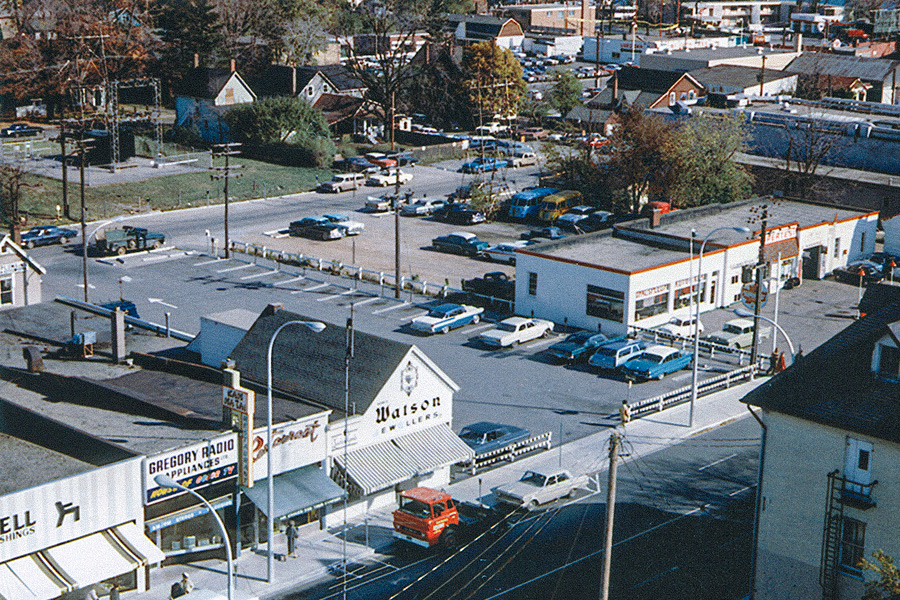
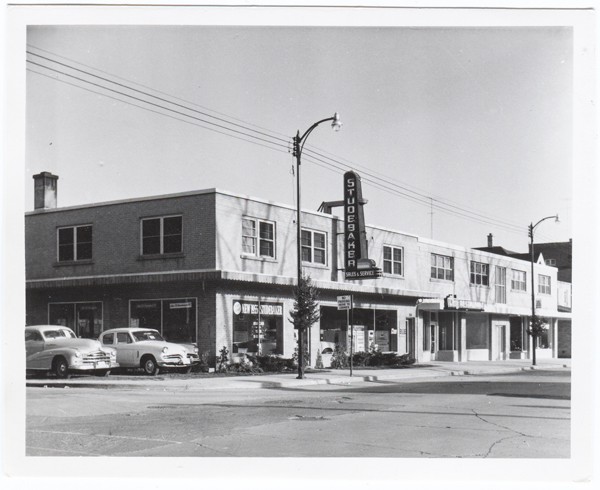
If you stand at the foot of Brant Street and look up from Lakeshore Road, it’s hard to imagine anything but a bustling main corridor – yet, not that long ago, Brant Street was nothing more than a dirt road with a smattering of stores.
Since the 1800s, however, the city’s main artery has been transformed from a quiet country road in a small village to the lively city street that exists today. The evolution of Brant Street has been marked by several key developments, one of which occurred in 1947 when the street saw the opening of its first grocery store. At the time, there had only been a greengrocer. The arrival of a new grocery store was met with such excitement that crowds lined the streets.
In 1954, another grocery store came to Brant Street triggering an even larger celebration. Not only did the opening of Loblaw’s draw a huge crowd but promoters even brought in a helicopter.
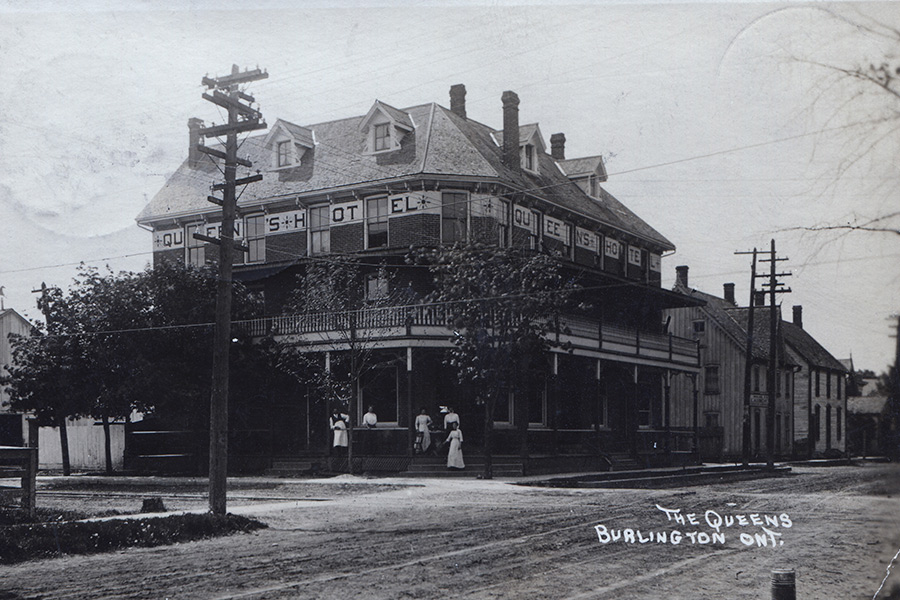
In the 1960s, the stores along Brant Street reflected the lifestyles of the residents and included Crest Hardware, one of five hardware stores on the street, alongwith a watchmaker, bakery, and shoe store. Then there was Queen’s Hotel, which was built in 1860 as Zimmerman House (later becoming the Sherwood Inn, followed by Coronation House). The area was also an employment hub, with a cannery factory on the lake at the foot of Brant Street, providing jobs for many in the surrounding area.
The change that perhaps most defined the street’s future came in 1965 with the construction of Burlington’s Town Hall. Built on the site of the old library, Town Hall, later renamed City Hall, was the only building of its stature at the time.
In 1966, the street underwent the ‘Brant Street Spruce-Up’. A sign of its growing popularity – some buildings were renovated and the street and sidewalks received a facelift.
The 1970s brought a lull to the downtown due to the popularity of the new Burlington Mall, which opened in 1968. Since then, however, many changes have been introduced to rejuvenate downtown, and today’s Brant Street has pulled shoppers back to the core.
Walking down Brant Street today, you’ll find an assortment of unique and local shops, including home decor stores like Centro and Pure Boutique, and eateries and cafes like The Queen’s Head, Saigon on Brant, and the famous Kelly’s Bake Shoppe. For those who are fashion-forward, Brant Street has Bush’s, Posh Couture, Joelle’s and Jeff’s Guy Shop, and Mirella’s, all popular clothing boutiques – and you can even get inked at The Tell Tale Heart Tattoo and Gallery.
Also downtown is Burlington’s oldest funeral home, Smith’s Funeral Home, which came to Brant Street in 1942.Down the street is Wendel Clark’s Classic Grill and Bar and further toward the lake is sweet-spot CastelynBelgian Chocolates.
The popularity of Brant Street today has been closely tied to developments at Spencer Smith Park, once a small shoreline park called Lakeside Park and renamed Spencer Smith Park in 1942.
Over the years, the many festivals at Spencer Smith Park, including Ribfest and the Sound of Music, have introduced thousands of people to Brant Street. But many people are unaware of the park’s beginnings – a landfill site that originally sat where Brant Street meets Lakeshore Road.
Another little-known fact is that Brant Street was named after Joseph Brant, a Mohawk military and political leader, and the surrounding streets, including Caroline and Elizabeth, were named after his family members.
The opening of the Brant Street Pier in June 2013 was another significant change that brought more people to the core. There are more changes on the horizon, and some aren’t without controversy, specifically the plans for a high-rise across from City Hall.
While the dirt road of yesterday is long gone, Brant Street still remains central to the city’s identity – and who knows where it will go from here.
We all know someone who, in some way, has served our country. It could be a great-grandparent, it could be a friend, it could even be yourself. Being a veteran does not stop at the World Wars. Today, there are members of our community volunteering their lives, both locally and overseas, to protect our country, our people, and ensure our future.
On November 11th, we remember a piece of our history and the people who served and continue to serve our country. This Remembrance Day, there will be several events in both Burlington and Oakville to honour the memory of fallen soldiers and those who serve for our nation’s defence.
Oakville
Remembrance Day Parade
The parade will begin at the Legion branch and proceed via Lakeshore Road to the Chris Vokes Memorial Park in Bronte. November 10th, 2019 at 10.30 a.m.
Royal Canadian Legion,
Branch 486
79 Jones Street, Bronte
George’s Square Ceremony
The veterans’ parade will proceed along Lakeshore Road to Trafalgar Road into St. George’s Square. Ceremony of remembrance to follow. November 11th, 2019 at 10.30 a.m.
George’s Square,
179 Trafalgar Road, Oakville
Burlington
Sunrise Remembrance Day Service
This 30-minute ceremony takes place at the Naval Ships Memorial Monument in Spencer Smith Park. For more information, contact the Burl-Oak Veterans at 905-632-3118.
November 11th, 2019 at 9 a.m.
Spencer Smith Park
1400 Lakeshore Road, Burlington
Remembrance Day Parade
The parade starts at Central Public School and will travel Brant to Elgin Street, Elgin to Locust Street, and Locust to Ontario Street. November 11th, 2019 at 10:30 a.m.
Central Public School
638 Brant Street, Burlington
Remembrance Day Service
This 45 to 60-minute ceremony is held at the Cenotaph, on the north side of City Hall. For more information, contact the Royal Canadian Legion Branch 60 at 905-639-6400. November 11th, 2019 at 11 a.m.
Cenotaph, City Hall
426 Brant Street, Burlington
Imagine coming home at night just after dusk and the exterior lights are already on to pre-set levels. As you enter your code into the door lock, your alarm is deactivated and the lights inside turn on to guide you into the kitchen – and on the TV, your favourite evening program is playing. Upon retiring to bed, you hit ‘bedtime’ on the touchscreen remote – this turns off all of the TVs in the home, all of the overhead lights, and lights a pathway on the stairs. The security alarm is set. Your home is asleep and safe —all from the touch of a single button.
In the morning, your shades open at sunrise easing you gently into the next workday. When leaving for the day, no need to run around to turn off lights, TVs, or adjust the blinds – you just hit ‘goodbye’ on the touch screen as you walk out the door. The alarm is set, TVs and lights are off, the shades follow the sun and open/close as needed, all on their own. Unless, of course, you get to work and realize that you forgot to lock the door, in which case, there’s an app for that too… With a smart home system, when you’re not at home, you’re never really away from home. When the doorbell rings, you can check your security cameras from your phone just to make sure all is safe and sound. When your teenager comes home from school, you can make sure they’re eating the dinner you left in the fridge rather than ordering in a pizza. Smart home technology is nothing more than security and solutions.
This is how Sarah Love of PM WYRE in Burlington describes the benefits of a fully-automated smart home. In short, Love says “A fully automated smart home is a seamless integration of technology into our lives, in which the everyday tasks are simplified into non-existence.” Robert May of Sounds Good AVS Solutions in Oakville agrees, “If the product and system are done right, there shouldn’t be a learning curve. It should involve hitting one or two buttons and having it work.”
When it comes to choosing a system, both Love and May say each home and homeowner has unique needs – and the notions of ‘smart’ accessories can vary widely. Using a smart home professional such as PM WYRE or Sounds Good AVS Solutions, and scheduling a home visit is key to understanding where to start with a system. “Smart home technology is not a cookie-cutter solution,” says Love, adding, “Each smart home should be designed with the clients’ needs, and lifestyle in mind – no matter the size of the system.”
PM WYRE
Before meeting with a professional, however, there are some things to consider, such as how you use each room, if you would like remote access, and if there are other people in and out of the home. There are so many options available and it’s just about finding the right solution for your needs.
Home automation systems have come a long way from a simple security system, and today theyinclude everything from entertainment, such as audio, video, television and music; comfort which includes lighting, climate control, and motorized window shades; security with a twist, which means not only protecting homeowners from burglary, but also flooding, leaks, natural gas, CO2, smoke and heat; and wellness, such as air filtration, and monitoring the overall quality of the home, including water. Thinking about how you would like to incorporate each of those monitoring methods or smart solutions into your home can help determine the type of system that would work best for you and your family.
Whatever level of technology you’re looking to embrace, May says going smart should provide a solution to a problem, not create more problems or headaches for homeowners.
The next time you’re at work wondering if you left the door unlocked or forgot to feed the dog, consider the benefits of smart technology – the freedom and flexibility will leave you liberated.
Mention early mornings and everyone gets the jitters. When you’re trying to get a busy family out the door – and on time – breakfast often is the last thing you think about. School bags, briefcases, sports bags, school lunches, and now they want breakfast too? Folks, believe it or not, it is possible to achieve a healthy nutritious breakfast. Here are a few ideas to gain superhero status in your family.
The key to success is to start breakfast preparation the night before. Alleviating most of the morning pressure is what makes a healthy grab-and-go breakfast suddenly possible. Make-ahead breakfast cookies are a way to ensure the most important meal of the day is consumed willingly. Many recipes are gluten-free, and can also be vegan or refined sugar-free. They are also freezer-friendly. Adding chia seeds and hemp hearts will provide omega 3, fibre, antioxidants, and protein. Protein powder can be added to give an extra boost of energy and leave you feeling full for longer. Play around with flavours like carrot cake or chocolate peanut butter. No one will resist your temptations or realize you’ve tricked them into a healthy start.
Yoghurt and fruit cups can be prepared and layered in a glass jar the night before. Add some granola or seed mix to create interest and texture. The jar can be washed and reused, making it great for the environment and cost-effective, too. Layer fresh seasonal fruit with Greek yoghurt or even make your own compote from fruit that is ripening faster than you can eat it.
Egg muffins (also called mini frittatas) are a high-protein, easy to eat breakfast. They can be made the night before and stored in the fridge for the next few days. Beat eggs with any flavour of your choice: cheese, spinach, peppers, bacon, or mushrooms and bake in deep muffin cups until they are set. Super quick and so nutritious you won’t even be hungry by lunchtime.
Healthy granola bars can come in any flavour with additions of nuts, seeds, or protein to make you feel more satisfied. They can provide a great breakfast and can also be used for school lunches. Freezer breakfast sandwiches are another great solution and can be pre-made and grabbed as you rush out of the door. Once you’ve perfected the breakfast sandwich, switch it up with frozen breakfast quesadillas, filled with scrambled eggs, black beans, corn, and cheese.
A family favourite is peanut butter and banana overnight oats. It’s vegan and gluten-free and can be pumped up to superfood status by adding chia seeds. Pop it into reusable glass jars and you’ve got a budget-friendly, healthy, enviro-friendly meal.
Smoothies are another easy choice and the flavour possibilities are endless. Green Press (greenpress.ca) in Oakville and Bodhi Bar (bodhibar.ca) in Burlington produce freshly pressed organic juices and shots (such as ginger or turmeric) and will deliver to your home. With blends including kale, spinach, cucumber, celery, green apple, parsley, ginger, and lemon,it’s a great way to load yourself and the kids up with antioxidants and vitamins A, C, E, and K.
For other busy homes, Savor Living (savorliving.ca) in Oakville produces healthy breakfasts delivered to your door. You can order a la carte or sign up for a meal plan. All their food is vegan (and delicious). Try any of their jars or waffles, you can’t go wrong.
A little organization and preparation the night before will ensure you and your family eat a full balanced breakfast, leaving you ready to take on the day.
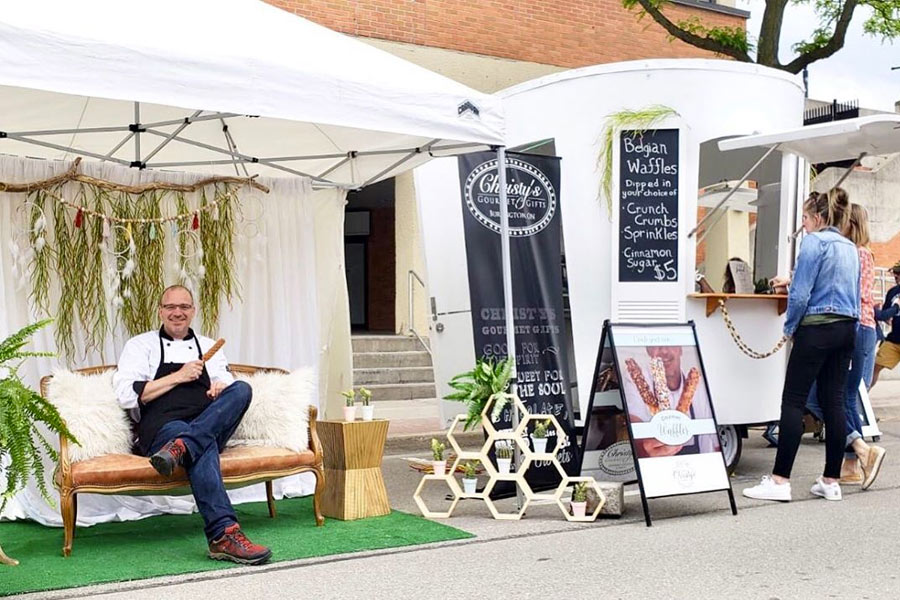
When Christy first called her husband, Bernhard, and told him she was going to sell buttercrunch at a craft show, he replied, “That’s great, just don’t expect me to help.” Sixteen years later, he’s the master chocolatier at their gourmet gift shop in Burlington, traveling all over the world to meet farmers and source ingredients.
How did you first get started?
C) We started very small, experimenting with my grandma’s recipe (which was my “Crunch”) and doing craft shows while I was on maternity leave.
What’s the division of labour now?
B) I do all the heavy lifting, Christy does all the mind work. When I’m in the back and I see Christy walk in, I tend to cringe.
C) It usually starts with “I have an idea” and he tries to run!
How do you keep the creativity going?
C) We both love to travel, try new food, and see new things. We’re always inspired by something and try to put our spin on it.
B) My goal is to create something that doesn’t exist—something that’s new and innovative and tastes good. That’s always my focus, and then Christy jumps in and tweaks it. We’ll even go through several types of butter to find the right one. It may be a bit more expensive, but to us, it’s worth it. If you’re going to eat those calories, you might as well go for the good stuff.
Stephanie Finn is the founder and creative director of Burlington MADE handmade and foodie markets, and a small business coach serving creative entrepreneurs at Stephanie Street Co. We’re excited to welcome Stephanie’s voice and her new features on local makers to Look Local Magazine.
Do you remember the thrill that came with pencils racing across a piece of paper as a teacher scribbled notes across the chalkboard? And by thrill, we mean panic. There was never a guarantee one could scribble fast enough to gather that day’s lesson. Then there was the collective moan that came with the sight of an overhead projector – a sure sign students were in for some lengthy notetaking…followed by a hand cramp. Before Dropbox, there was the floppy disk, before iPads – a notebook, and long before the classroom technologies of today, there was the clunky technology of the ‘90s that paved the way.
For students of today, technology has come a long way from colourful, original iMac computer labs and the infamous rolly-cart TV. Modern students have access to everything from virtual field-trips, video conferencing, digital portfolios, online guest speakers, and more. Their technology is a broad term and encompasses many things such as computer hardware, software, and applications as well as large and small machinery including laser cutters, smartphones, iPads, and digital cameras.
Julie Hunt Gibbons, superintendent of secondary program and student success for Halton District School Board, says parents, teachers, students, staff, and community members expect the use of technology in the classroom to enhance both teaching and learning – after all it is the 21st Century and young people today are often described as ‘digital citizens’.
With technology an increasing requirement in almost every industry, it only makes sense that our schools are also effectively deploying mobile technology in the classroom. However, for many schools, implementing the latest technology is a difficult strategy to navigate.
“The biggest challenge in the use of technology in school, as it is globally, is protecting the privacy of all engaged,” says Lisa M. Duranleau, Executive Director at MacLachlan College. Hunt Gibbons agrees, “ensuring the privacy of our students is a priority for our Board. That is why our Board has implemented a software catalogue for our teachers to use. The catalogue identifies “green” tools that teachers can use in their classrooms.” At MacLachlan, acceptable use policies are continuously updated while teachers and students are constantly educated on how to navigate their way through emerging technologies. Other challenges include the choice of tool, equity of access to tools, safety concerns, and staff development.
Despite the challenges, both Lisa and Julie agree technology is an essential component of today’s classroom tool kit. “Utilizing new approaches through inquiry and participatory technology inspires students to ask questions, research, and think critically to find solutions for an evolving world,” says Lisa. Students are exposed to real-world, authentic experiences.
Through virtual field trips, they can travel around the world, understanding and resolving problems as a reflective citizen. Technology has become an incredible tool for critical thinking and problem solving, innovation, creativity and entrepreneurship, and self-directed learning. While technology is the tool, the success of its use is dependent on the facilitators that guide students in their learning – because it’s not just the technology a school has in its classroom but the application of the technology and the learning outcomes.
From kindergarten through to grade 12, Halton students are being exposed to the wonderful benefits of learning through technology. The future of education relies on building a community of collaborators – students, teachers, and parents – and technology is central to community building. While there is no way to predict where technology will go from here, educational leaders are required to morph their practices to best prepare children of today to be global citizens of tomorrow.